 Josef von Sternberg’s The Devil is a Woman (1935) was based on La Femme et le Pantin (The Woman and the Puppet) by Pierre Louys, an 1898 novel that was also the basis of Luis Bunuel’s 1977 masterpiece That Obscure Object of Desire. Louys is also famed for his more explicit erotica such as Trois Filles de Leur Mere, published anonymously in 1926, a year after his death in Paris. Bunuel’s version was co-written by Jean-Claude Carriere and starred Fernando Rey as Mathieu and both Angela Molina and Carole Bouquet
  in the role of the bedeviling tease Conchita. In Von Sternberg’s version, which was written by John Dos Passos, Marlene Dietrich plays the Sevillian flamenco dancer Concha Perez, a fiercely independent woman with “ice for a heart” who beguiles Lionel Atwill as “Pasqualito” and Edward Everett Horton as “Paquitito,” as she affectionately nicknames them (look for Cesar Romero in a small role as well). The film, like Bunuel’s, is told in a series of flashbacks, here to the tune of "El Gato Montes" and other pasodobles. Much of the story was told visually through the bars of iron gates and fences as well as in the presence of caged birds,
  reinforcing the theme of Atwill's imprisonment by becoming more and more elaborate as the movie progresses. As they return home together one night, Dietrich declares “Look mama I caught a fish,” holding up a goldfish in a glass bowl. Even as she repeatedly rebuffs Atwill's amorous advances, she ensnares him deeper and deeper into an intricate emotional plexus; he offers protection from worry (and cash to her mother) but she insists that she does not want a father or husband or any man to control her. Yet when he violently beats her, she returns to him in the morning happier than ever. Though difficult to accept Dietrich as Spanish, the film features the memorable song “he gives me butter and carrots and onions that no other farmer would . . . and other things that are so good.” Filmed in Hollywood, this was Von Sternberg and Dietrich’s last film together, ending a famed collaboration that included Morocco (1930), The Blue Angel (1930), Blonde Venus (1932), and Shanghai Express (1932). Von Sternberg later made the sly Shanghai Gesture (1941) with Gene Tierney and Victor Mature. La Femme et le Pantin was also filmed by Julien Duvivier in 1958, starring Brigitte Bardot and Antonio Vilar, though it plays considerably more dated and straightforward than either the Von Sternberg or Bunuel versions of the same novel.
 His Kind of Woman (1951) was a kind of film-noirette set in Mexico and made by RKO, starring Robert Mitchum as the sap Dan Milner and Jane Russell as singer Lenore Brent. The production, like many headed by Howard Hughes, was filled with false starts, conflicting direction, jealousy, pride, envy, etc. The film was directed by John Farrow, better known for The Big Clock (1948) with Ray Milland and Maureen O’Sullivan (Farrow's longtime wife) and Hondo (1953) with John Wayne and Geraldine Page--who is always slightly disturbing once you've seen Don Siegel’s Civil War film The Beguiled (1971) with Clint Eastwood. Farrow also wrote the screenplay to the excellent adaptation of Jules Verne’s Around the World in 80 Days (1956) starring David Niven and Cantinflas.
  Filmed by Harry Wild, whose credits include Johnny Angel (1945), Murder My Sweet (1945), and Macao (1952), His Kind of Woman traces the story of loner Mitchum on vacation at a seaside Mexican resort and his involvement with Russell; Raymond Burr as mobster Nick Ferraro; Vincent Price as vacationing actor Mark Cardigan. Like all noirs, the film addresses the whims of fate and the hidden motivations behind courtship, crime, and love. Jane Russell’s name “Lenore” is nearly synonymous with young death, as it was used repeatedly in the poetry of Edgar Allen Poe (Price's presence reinforces the connection to Poe). A film that does not quite live up to the sum of its many parts, it is still a work of note for any fan of Mitchum, Russell, Price, Burr, Hughes, RKO, movies set in Mexico, or all of the above.
 One of the funniest movies of the 1980s, D.C. Cab (1983) delivers hilarious comedy and first-rate social commentary at the same time in way that few films can match. As a kid, everyone saw this movie in the theater as it was Mr. T's follow-up to Rocky III and premiered during the first season
  of The A-Team. D.C. Cab was one of many "inspirational" movies that came out from 1976-1986 (look it up) but one of the very few that offered such an obvious critique of the Reagan administration by calling for collective action over personal glory (the film's locale was the first hint). Directed by Joel Schumacher (The Lost Boys), the film is the story of the wide-eyed Albert Hockenberry who comes to the inner city to work at the cab company owned by Harold, his deceased father's buddy from Vietnam. D.C. Cab,
  of course, is the misfit cab company, employing the indigent, indulgent, and apathetic alike. It is also extremely diverse, from the cross-dressing Tyrone to the would-be ladies man Xavier to the Barbarian Brothers. Will this motley group band together to save D.C. Cab? The film stars: Max Gail, Mr. T, Gary Busey, Bill Maher (yes, that Bill Maher), Paul Rodriguez, Jill Schoelen, and features Timothy Carey in one of his last screen roles as well as 1980s sensation Irene Cara ("Flashdance," "Fame") as herself. The cinematography was by Dean Cundley, a John Carpenter regular who pioneered the use of the steadicam on Halloween, and who also filmed The Fog, Escape From New York, Who Framed Roger Rabbit, Back to the Future ,Romancing the Stone, Jurassic Park, and Roadhouse.
 Barry Mahon's voyeuristic The Sex-Killer (1966) has been one of my favorite films from Something Weird Video for some time, having purchased a VHS copy from their catalog about 15 years ago. Filmed on location in New York in (what appears to be) 16mm black & white, The Sex-Killer is the surreal and strange story of Tony, a creepy and reclusive worker in a
  Garment District mannequin factory. Tony’s favorite hobby, when not trying to sneak broken mannequins home with him for “dates” at a local bar, is to utilize his high-powered binoculars from the roof of his building on unsuspecting sunbathers (there was apparently a lot of nude rooftop sunbathing in those days). The film features Uta Erickson, Helena Clayton, Rita Bennett (a Mahon regular), and Sharon Kent as Tony’s various girlfriends/murder victims. Mahon was a film producer, director, writer, and cinematographer of various mid-sixties Z-grade movies. His directorial canon
  betrays a common theme: She Should Have Stayed in Bed (1963), Bunny Yeager's Nude Camera (1963), Nudes on Tiger Reef (1965), Nudes Inc. (1965), The Love Cult (1966), and P.P.S. - The Prostitutes Protective Society (1966). His first feature, however, was called Cuban Rebel Girls aka Assault of the Rebel Girls (1959), which was co-written by and starred Errol Flynn in his last screen role, along with his 16-year old girlfriend Beverly Aadland. Flynn plays himself as a war correspondent, assisting Fidel Castro’s revolution against the Batista government. Flynn, who lived in Havana at the time, also appeared in the amazing lost-documentary
  by Victor Pahlen called "The Truth about Fidel Castro Revolution," recently released as Cuban Story. Barry Mahon, who had become close friends with Flynn, had a life story to match the tales recounted in Flynn’s hilarious autobiography My Wicked, Wicked Ways (also released in 1959, the year of Flynn’s death at age 50). Born and raised in California, Mahon volunteered for the Royal Air Force in 1941 months before Pearl Harbor, earning an outstanding reputation as a fighter pilot before being shot down over the ocean on August 19 1942. Taken prisoner by the Germans, he was held at Stalag Luft III, where he helped dig the escape tunnels made famous by the John Sturges film The Great Escape (1963). The baseball-tossing character of Captain Hilts, played by Steve McQueen, was partly based on Mahon.
 Simon of the Desert was Luis Bunuel's last film made in Mexico, released in 1965. One of the few movies based on an original story by Bunuel, its source material was the life of Saint Simeon Stylites--a Fourth Century hermit who spent 37 years atop a 60-foot column outside of Aleppo (modern day Syria). In My Last Sigh Bunuel wrote that he was first introduced to Simeon Stylites by Federico Garica Lorca, who had given him a copy of Jacobus de Voragine's The Golden Column (written circa 1260-1275),
  a kind of a cult-book lives of the saints that was very popular in Medieval Europe. The book detailed Simeon's diet and excrement, which amused Bunuel and Lorca when they were students in Madrid. The rest of the story was researched at the New York Public Library on 42nd Street. Though many scenes of the film were cut (or never shot), the film won 5 awards at the Venice Film Festival including the Special Jury Prize. At 45 minutes long, the film (still rarely shown in movie theaters) stars Claudio Brook as Simon and Sylvia Pinal as the trickster Satan, arriving to tempt Simon in various disguises including a bearded Jesus carrying a lamb,
  in a self-propelled coffin, and as a school-girl in a sailor suit complete with stockings and suspender belt. Pinal, a popular Mexican actress who had starred in Bunuel's other two last Mexican films, the brilliant Viridiana (1961) and The Exterminating Angel (1962), was excellent as the temptress devil, revealing her legs, exposing her breasts, and caressing the beard of the implacable Simon del desierto. Shot by Gabriel Figueroa and edited by Carlos Savage, the film presents the absurdity of Catholicism while at the same time exposing Bunuel's basic belief in a higher ascetic lifestyle. Motifs, of course, abound as well: women's legs, ants, solitude, the dual nature of freedom/enslavement. The most shocking aspect of Simon of the Desert, upon rewatching,
  is how closely the film prefigures many visual and narrative elements of his later work in France (usually viewed as a stylistic break from his Mexican films). The shots are so similar that you could dissolve from Silvia Pinal's legs directly onto Jeanne Moreau's in Diary of a Chambermaid and wind up in another century and country. Of course, that is exactly what happens in Simon of the Desert as well, as Pinal takes Simon (via airplane) to the very bottom depths of hell (for Bunuel): a Greenwich Village disco where the kids dance the last dance aka the "Radioactive Flesh." Simon, his beard closley trimmed, idly smokes a pipe as he sits alone amongst the pre-hippy crowd. The overhead shots of the East River and Manhattan skyline were perhaps Bunuel's only filmed of New York (I cannot think of any others). Simon of the Desert's disjointed narrative/fantasy structure (which he had not used in this way before) also foreshadowed both Belle de Jour (1967) and The Milky Way (1969). The column used for Simon was too heavy to move and remains today in the field in Mexico where they filmed the movie.
 There was a near-riot at MOMA last week during Alfred Hitchcock's Spellbound (1945) when the audience at a 4:30pm screening mistook the 5 minute overture for an incompetent and/or sleeping projectionist. Yelling, shouting, and a strange dirge-like clapping were met by reactionary counter-yelling and bemused laughter until someone finally called out "this movie premiered with an overture!" The restlessness, panic, and anxiety that these darkened 5 minutes provoked whipped the elderly would-be hooligans in the crowd to a frenzy--you can't imagine just how close they were to ripping up the seats and storming the projection booth. Starring
  Ingrid Bergman and Gregory Peck (in his first major role), the film was written by Hollywood legend Ben Hecht, who also wrote His Girl Friday (1940), Notorious (1946), and Kiss of Death (1947). Peck played Dr. Anthony Edwardes, the newly-arrived director of the secluded clinic Green Manors, where he meets Bergman's Dr. Constance Petersen, a sexually-repressed psychoanalyst (Hitchocock and Hecht were not shy with the "librarian" and "egg-beater" jokes). The David O. Selznick production featured the famous dream-sequence painted and choreographed by Salvador Dali and a theremin-heavy score written by Hungarian composer Miklos Rozsa. The innate connections between Hitchcock and Luis Bunuel were most apparent in Spellbound; though the Dali sequence remains the most obvious, with Dali cutting eyeballs with
  giant scissors in an homage to Un Chien Andalou, Peck's journey through the Labrynth of the Guilt Complex directly anticipated Bunuel's Rehearsal For a Crime (1955) by commenting on childhood murder-fantasy and the return of the repressed. Peck's amnesia, however, was not triggered by a long-lost music box but rather through visual stimuli, which provided reason for one of Hitchcock's most macabre shots of all time. Another basic connection between the two masters of (surrealist) cinema is Hitchcock's latent Catholicism, which was here on full display, expressed as usual in fetishism and guilt. This particular screening was perhaps one-of-a-kind, as the near riot amidst the suffocating smell of the Bloomingdale's perfume counter added a heightened anticipation of violence and was the perfect set-up for the psychological thriller. The film features Hitchcock trademarks such as projected backgrounds, visual-textual juxtapositions (i.e. Peck and Bergman declaring that it is not love between them as they kiss for the first time), as well as beautiful shots of Old Penn Station and Grand Central Terminal.
 Tony Manero (2009), which opened at Cinema Village this month, is a disturbing and important film set in Pinochet's Santiago, circa 1978, when the cold reality of the United States-backed coup, thousands of political executions, constant surveillance by secret police, a steady stream of exiles, and forced free-market economics were converging into a feel of permanence over Chile. Under military dictatorship, political repression becomes paralleled by personal detachment; silence rules over discussion; life becomes cheap.
 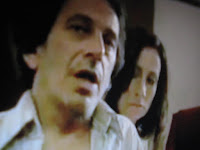 Directed by Pablo Larrain, the film starred Alfredo Castro (who was also co-writer with Larrain and Mateo Iribarren) as Raul/Tony Manero, a loser in his mid-50s caught between Pinochet and Travolta. On surface level, the film is a dark comedy about a Saturday Night Fever-impersonator who will kill, literally, for his art. But the film is pure tragedy, and Tony's cold-blooded obsession was not played with a wink to the audience ala American movies. Castro's performance was matched in empty ruthlessness (glass) brick by brick by that of the film's co-stars (and Tony's co-stars in their Saturday Night Fever act performed at a local cafe):
  Amparo Noguera (as Cony, his lover), Paola Lattus (as Pauli, Cony's daughter), Héctor Morales (as Goyo, Pauli's socialist boyfriend) and Elsa Poblete (as Wilma-the cafe owner). The women were the true emotional touchstones of the film, strange combinations of resilience, resignation, and desperation who (each) cling to Tony in spite of his impotence, emptiness, and distraction (perhaps the common man under Pinochet). Strange, disturbing, and ugly, the film presents a narrative of modern South America that is far removed from the poetry of Garcia Marquez or Borges or the Chile of Bolano or Jodorowsky. The sometimes blurry, hand-held scenes, filmed by Sergio Armstrong and edited by Andrea Chignoli, add to the movie's overall feeling of dislocation and detachment. Tony Manero (the film and character) does not simply take
  Saturday Night Fever as a starting point, instead enmeshing itself into the social tensions of Bay Ridge, the desperation of youth, the whiteness of Tony's suit/dreams (perfectly replicated by Raul/Tony and other contestants in the Saturday afternoon Chilean variety show to which the film builds its arc), and the exaltation of dance explored in the film by John Badham (Blue Thunder, War Games). With deadpan brutality diffused everywhere, leaking out of rusted pipes, shining beneath the dance floor, hiding in the hall closet, crawling through the dead grass, the film's horrors get more frightening the farther away from the picture you get. But is the story of a Chilean loser obsessed with New York disco supposed to have a Hollywood ending?
 Josef von Sternberg’s The Devil is a Woman (1935) was based on La Femme et le Pantin (The Woman and the Puppet) by Pierre Louys, an 1898 novel that was also the basis of Luis Bunuel’s 1977 masterpiece That Obscure Object of Desire. Louys is also famed for his more explicit erotica such as Trois Filles de Leur Mere, published anonymously in 1926, a year after his death in Paris. Bunuel’s version was co-written by Jean-Claude Carriere and starred Fernando Rey as Mathieu and both Angela Molina and Carole Bouquet
  in the role of the bedeviling tease Conchita. In Von Sternberg’s version, which was written by John Dos Passos, Marlene Dietrich plays the Sevillian flamenco dancer Concha Perez, a fiercely independent woman with “ice for a heart” who beguiles Lionel Atwill as “Pasqualito” and Edward Everett Horton as “Paquitito,” as she affectionately nicknames them (look for Cesar Romero in a small role as well). The film, like Bunuel’s, is told in a series of flashbacks, here to the tune of "El Gato Montes" and other pasodobles. Much of the story was told visually through the bars of iron gates and fences as well as in the presence of caged birds,
  reinforcing the theme of Atwill's imprisonment by becoming more and more elaborate as the movie progresses. As they return home together one night, Dietrich declares “Look mama I caught a fish,” holding up a goldfish in a glass bowl. Even as she repeatedly rebuffs Atwill's amorous advances, she ensnares him deeper and deeper into an intricate emotional plexus; he offers protection from worry (and cash to her mother) but she insists that she does not want a father or husband or any man to control her. Yet when he violently beats her, she returns to him in the morning happier than ever. Though difficult to accept Dietrich as Spanish, the film features the memorable song “he gives me butter and carrots and onions that no other farmer would . . . and other things that are so good.” Filmed in Hollywood, this was Von Sternberg and Dietrich’s last film together, ending a famed collaboration that included Morocco (1930), The Blue Angel (1930), Blonde Venus (1932), and Shanghai Express (1932). Von Sternberg later made the sly Shanghai Gesture (1941) with Gene Tierney and Victor Mature. La Femme et le Pantin was also filmed by Julien Duvivier in 1958, starring Brigitte Bardot and Antonio Vilar, though it plays considerably more dated and straightforward than either the Von Sternberg or Bunuel versions of the same novel.


