 There was a near-riot at MOMA last week during Alfred Hitchcock's Spellbound (1945) when the audience at a 4:30pm screening mistook the 5 minute overture for an incompetent and/or sleeping projectionist. Yelling, shouting, and a strange dirge-like clapping were met by reactionary counter-yelling and bemused laughter until someone finally called out "this movie premiered with an overture!" The restlessness, panic, and anxiety that these darkened 5 minutes provoked whipped the elderly would-be hooligans in the crowd to a frenzy--you can't imagine just how close they were to ripping up the seats and storming the projection booth. Starring
  Ingrid Bergman and Gregory Peck (in his first major role), the film was written by Hollywood legend Ben Hecht, who also wrote His Girl Friday (1940), Notorious (1946), and Kiss of Death (1947). Peck played Dr. Anthony Edwardes, the newly-arrived director of the secluded clinic Green Manors, where he meets Bergman's Dr. Constance Petersen, a sexually-repressed psychoanalyst (Hitchocock and Hecht were not shy with the "librarian" and "egg-beater" jokes). The David O. Selznick production featured the famous dream-sequence painted and choreographed by Salvador Dali and a theremin-heavy score written by Hungarian composer Miklos Rozsa. The innate connections between Hitchcock and Luis Bunuel were most apparent in Spellbound; though the Dali sequence remains the most obvious, with Dali cutting eyeballs with
  giant scissors in an homage to Un Chien Andalou, Peck's journey through the Labrynth of the Guilt Complex directly anticipated Bunuel's Rehearsal For a Crime (1955) by commenting on childhood murder-fantasy and the return of the repressed. Peck's amnesia, however, was not triggered by a long-lost music box but rather through visual stimuli, which provided reason for one of Hitchcock's most macabre shots of all time. Another basic connection between the two masters of (surrealist) cinema is Hitchcock's latent Catholicism, which was here on full display, expressed as usual in fetishism and guilt. This particular screening was perhaps one-of-a-kind, as the near riot amidst the suffocating smell of the Bloomingdale's perfume counter added a heightened anticipation of violence and was the perfect set-up for the psychological thriller. The film features Hitchcock trademarks such as projected backgrounds, visual-textual juxtapositions (i.e. Peck and Bergman declaring that it is not love between them as they kiss for the first time), as well as beautiful shots of Old Penn Station and Grand Central Terminal.
 Tony Manero (2009), which opened at Cinema Village this month, is a disturbing and important film set in Pinochet's Santiago, circa 1978, when the cold reality of the United States-backed coup, thousands of political executions, constant surveillance by secret police, a steady stream of exiles, and forced free-market economics were converging into a feel of permanence over Chile. Under military dictatorship, political repression becomes paralleled by personal detachment; silence rules over discussion; life becomes cheap.
 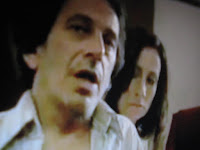 Directed by Pablo Larrain, the film starred Alfredo Castro (who was also co-writer with Larrain and Mateo Iribarren) as Raul/Tony Manero, a loser in his mid-50s caught between Pinochet and Travolta. On surface level, the film is a dark comedy about a Saturday Night Fever-impersonator who will kill, literally, for his art. But the film is pure tragedy, and Tony's cold-blooded obsession was not played with a wink to the audience ala American movies. Castro's performance was matched in empty ruthlessness (glass) brick by brick by that of the film's co-stars (and Tony's co-stars in their Saturday Night Fever act performed at a local cafe):
  Amparo Noguera (as Cony, his lover), Paola Lattus (as Pauli, Cony's daughter), Héctor Morales (as Goyo, Pauli's socialist boyfriend) and Elsa Poblete (as Wilma-the cafe owner). The women were the true emotional touchstones of the film, strange combinations of resilience, resignation, and desperation who (each) cling to Tony in spite of his impotence, emptiness, and distraction (perhaps the common man under Pinochet). Strange, disturbing, and ugly, the film presents a narrative of modern South America that is far removed from the poetry of Garcia Marquez or Borges or the Chile of Bolano or Jodorowsky. The sometimes blurry, hand-held scenes, filmed by Sergio Armstrong and edited by Andrea Chignoli, add to the movie's overall feeling of dislocation and detachment. Tony Manero (the film and character) does not simply take
  Saturday Night Fever as a starting point, instead enmeshing itself into the social tensions of Bay Ridge, the desperation of youth, the whiteness of Tony's suit/dreams (perfectly replicated by Raul/Tony and other contestants in the Saturday afternoon Chilean variety show to which the film builds its arc), and the exaltation of dance explored in the film by John Badham (Blue Thunder, War Games). With deadpan brutality diffused everywhere, leaking out of rusted pipes, shining beneath the dance floor, hiding in the hall closet, crawling through the dead grass, the film's horrors get more frightening the farther away from the picture you get. But is the story of a Chilean loser obsessed with New York disco supposed to have a Hollywood ending?
 Paul Verhoeven's Turkish Delight (1973) starred Rutger Hauer and Monique Van der Ven as the star-crossed bohemian lovers Eric and Olga, who meet in the Netherlands when Van der Ven stops for the hitch-hiking artist Hauer. Told mostly in flashback, the film explores the charms, whims, and pettiness of new romance, of sexual escapade, of drunken debauchery. Like Keetje Tippel (aka Katie's Passion) (1975), which was set in 19th-century Amsterdam and also starred Hauer and Van der Ven, Turkish Delight seems at first glance like an anacronistic period piece, quite different in form, content, and philosophy from Verhoeven's American films such as RoboCop (1987), Total Recall (1990), Basic Instinct (1992), Showgirls (1995). But, even as such, both films demonstrate the same kind of disconnection to reality and the strange transient nature of life and death. Turkish Delight was not only one of Verhoeven's first features, but one of Hauer's as well, made a decade prior to Blade Runner (1982),
 Nicolas Roeg's
Eureka (1983), and Sam Peckinpah's Osterman Weekend (1983). In between this film and those, Hauer starred in the obscure Mysteries (1978), based on a Knut Hamsun novel about a enigmatic stranger, a suicide, a dwarf, and an ill-fated love triangle. Mysteries co-starred Sylvia Kristel (Emmanuelle) and Rita Tushingham (A Taste of Honey, The Leatherboys). Based on a novel called Turks Fruit by Dutch author and sculptor Jan Hendrik Wolkers (1925-2007), Turkish Delight ended rather melancholically for some tastes, but then again there's not much fun in brain tumors. The dubbed (vhs) versions of both Turkish Delight and Katie Tippel are awful, though the bad sync and cut-rate voiceover artists used in Katie Tippel are kind of funny at the same time.
 Sergio Leone's swan song, Once Upon a Time in America (1984), was an old man's lament about memory, absence, architecture, and the inevitability of death. Rightly called an epic poem of violence, greed, and betrayal, the film was also a masterpiece of narrative structure in which the ringing of a telephone inside of a Chinatown opium den initiates the (opium-induced) dream-memory-fantasy of "Noodles" Aaronson, the Jewish gangster played by Robert De Niro. The movie begins in the center, travels to the past, fades to the future, and returns/flashbacks to the center again, much as our dream life operates. Like Dostoevsky's Crime and Punishment (and the end of Taxi Driver), this "flashback" ending can be interpreted both as a dream itself and as a return to consciousness at the end of a dream. This film was in many ways Leone's lifetime project, as he had been ready to go into production since the early seventies. The principle cast, as assembled, was superb: James Woods as "Max" Bercowicz (aka Christopher Bailey); Larry Rapp as "Fats" Gelly; Elizabeth McGovern and Jennifer Connelly (pictured above at age 12) as Fats' sister Deborah, both true love and date-rape victim of De Niro. In smaller roles were Tuesday Weld; William Forsyth; Treat Williams; Joe Pesci; Burt Young; Danny Aiello. Marked with fantastic period settings that ranged from turn-of-the-century Lower East Side to the 1930s to 1968, the film was also supported by a tremendous score by Ennio Morricone (as usual). The film's dream-like narrative was centered in mythology, with the anti-hero De Niro returning from exile to New York City, the land of his boyhood. His return to Fats' bar was filled with an almost violent nostalgia, as he quietly surveys the building itself, the feel of the walls, the empty space, the removable plank in the bathroom wall from which he spied (and spies again) on his young love practicing ballet on the empty storeroom stage. The graphic violence, the corruption, and the betrayal seem to fade for De Niro, and Leone, beneath the inability to recover the lost dreams of youth.
 Otto Preminger's Bunny Lake is Missing (1965) masterfully toyed with its audience at MOMA last month with a tale of incest, intrigue, and insanity. Carol Lynley stars as an American single mother, alone in London, whose 4-year-old girl "Bunny" goes missing from elementary school on her first day. No one--including the audience--has seen Bunny, and chief detective Laurence Olivier would at least like a verifiable photograph of the child before prolonging his investigation into a second day. Lynley, a former child model and actress, was perfectly cast as the wide-eyed Ann Lake, her innocent optimism fading into a zoned-out deceitfulness, or so Preminger would have you believe. As usual in a Preminger film, the acting was superb: in addition to Olivier and Lynley, Bunny Lake featured Noel Coward as the alcoholic thespian/landlord with a collection of African masks and S&M relics (De Sade's "skull" and original whip); Martita Hunt as retired school owner Ada Ford whose studies of children's nightmares cannot but help drive the investigation forward; Kier Dullea as Lynley's brother in a performance rivaling Anthony Perkins in Hitchcock's Psycho or Karlheinz Boehm in Michael Powell's Peeping Tom (both 1960). The film was adapted from a novel by Evelyn Piper (
Merriam Modell)
that was recently republished by the CUNY Feminist Press. The wide-screen black & white cinematography by Denys Coop--who had previously shot the brilliant Billy Liar (1963) with Tom Courtenay and Julie Christie--perfectly matched Preminger's sinister pseudo-noir vision that was consistent in his work, whether set in London, New York, or the California coast. Among his finest films are Laura (1944), Fallen Angel (1945), The Man With the Golden Arm (1955), Saint Joan (1957). What separates Bunny Lake is Missing from his other work is that it is as subversive as it is suspenseful. Watch for The Zombies in an extended performance on British television performing "Just Out Of Reach"
during an important scene in a local pub.
 Barbet Schroeder's Maitresse (1976) has retained an "underground" following, which perhaps is all one can expect from an X-rated romantic dark comedy that graphically portrayed professional S&M encounters using real customers, real masks, real chains, real cages, real torture racks, whippings, piercings, nailings. The film also portrayed the nuances of romance, the
  power struggles in new relationships, the limits of 1960s sexual liberation, and the role of class differences in social movements. Bulle Ogier starred as Ariane, a dominatrix working out of the basement of her bourgeois apartment (actually a separate downstairs apartment that is connected by a hidden mechanical stairway). This is Ogier's finest role, though she is excellent in her other work for Schroeder, including The Vallee (1972), set in the New Guinea
  rainforest, and the gambling movie Tricheurs (The Cheaters) (1984). She also has the distinction of having worked for Luis Bunuel in The Discreet Charm of the Bourgeoisie (1972) and for taking on the Catherine Deneuve role of Severine in the 2006 sequel to Belle de Jour, called Belle Toujours which stars Michel Piccoli in his original role of Husson and was directed by (98 year old) Portuguese director Manoel de Oliveira. Starring alongside Ogier in Maitresse was Gerard Depardieu as Olivier, a cocksure ex-con who
  stumbles upon Ogier's dungeon while burglaring her building. Though Ogier attempts to keep her two worlds (and apartments, even with separate phones) separate, the lines between dominantion and submission blur as her relationship with Depardieu grows. He, still somewhat indignant to her lifestyle and her boss Gautier, tries to control her. She, by seducing him into her professional life, tries equally to control him. Neither the film nor these
  relationship boundaries are predictable or static, and Schroeder's tender "climax" of the film seems to suggest that only in masochistic desire--complete surrender--does true love reside. The film's extraordinary visuals--the domestic Parisian scenes, the dimly lit basement, the great scene at the country manor--were shot by Nestor Almendros, a Schroeder regular who won an Academy Award for Terrence Mallick's Days of Heaven (1979). The costumes were by Karl Lagerfeld. The breadth of Schroeder's work, like Werner Herzog, is both very obsessive and very diverse, directing feature films as well as
  documentaries such as General Idi Amin Dada: A Self Portrait (1974), Koko: The Talking Gorilla (1978), and The Charles Bukowski Tapes (1987). He was also, famously, an important figure in the French New Wave, producing, among other movies, Eric Rohmer's The Girl at the Monceau Bakery (1963), Nadja a Paris (1964), La Collectionneuse (1967), My Night at Maud's (1969), Claire's Knee (1970), Chloe in the Afternoon (1972). He later produced Fassbinder’s Chinese Roulette (with Anna Karina)(1976) and was featured in Pierre Zucca’s infamous Roberte (1979) based on the novel and artwork of Pierre Klossowski, translator and interpreter of De Sade and brother of the painter Balthus.
 Tattooed Life (aka Irezumi Ichidai) was an existential Yakuza film made by Seijun Suzuki in 1965 for the Nikkatsu Film Corporation during one of Seijun's most prolific and controversial eras. It was preceded by Gates of Flesh (1964) and Story of a Prostitute (1965) and followed by Tokyo Drifter (1966) and the classic Branded to Kill (1967). By the end of the decade he was fired from Nikkatsu and essentially banned from making movies in Japan; his resurfacing in the 1980s pleased many of his loyal fans.
  Yakuza movies were strictly b-movies and Seijun was like a Japanese Sam Fuller, figuring that as long as his pictures came in on time and under budget anything goes. Yakuza films, of course, also predate other "tattoo" films such as the hallucinatory Illustrated Man with Rod Steiger (1969) (based on a Ray Bradbury short story) and David Cronenberg's Russian mafia movie Eastern Promises (2007) with Viggo Mortensen and Naomi Watts. Tattooed Life starred Hideki Takahashi as Tetsu
 the "White Fox" (or "Silver Fox" depending on your translation) and Masako Izumi as Midori who falls in love with the marked man with a secret past. Tetsu and his art-school brother Kenji (Kotobuki Hananomoto) are on the run from a killing (in self defense) and arrive in a port city on the Sea of Japan seeking passage to Manchuria where they can escape the police and the Yakuza family who is chasing them. While working for a small
  mining company, the brothers meet Midori and her sister Masayo (Hiroko Ito), who happens to be married to the boss of the mining company. The brothers are pursued by a strange man in red shoes, and dodge text-book shady waterfront characters left and right, including the pencil-pushing Ezaki (Yuji Odaka) whose unrequited love for Midori drives him toward jealous revenge. Tetsu, who has raised his younger brother since childhood (their parents died when they were young) warns him that "sometimes there are things you have to give up when you become a man" and "don't get carried away by emotion." Kenji's death, it seems, was fated when he was unable to control his forbidden love for the married Masayo. The film, which features many shots with character's backs to the camera, through open windows, etc., works despite its cardboard characters, sparse dialogue, and see-through plot lines.
 There was a near-riot at MOMA last week during Alfred Hitchcock's Spellbound (1945) when the audience at a 4:30pm screening mistook the 5 minute overture for an incompetent and/or sleeping projectionist. Yelling, shouting, and a strange dirge-like clapping were met by reactionary counter-yelling and bemused laughter until someone finally called out "this movie premiered with an overture!" The restlessness, panic, and anxiety that these darkened 5 minutes provoked whipped the elderly would-be hooligans in the crowd to a frenzy--you can't imagine just how close they were to ripping up the seats and storming the projection booth. Starring
  Ingrid Bergman and Gregory Peck (in his first major role), the film was written by Hollywood legend Ben Hecht, who also wrote His Girl Friday (1940), Notorious (1946), and Kiss of Death (1947). Peck played Dr. Anthony Edwardes, the newly-arrived director of the secluded clinic Green Manors, where he meets Bergman's Dr. Constance Petersen, a sexually-repressed psychoanalyst (Hitchocock and Hecht were not shy with the "librarian" and "egg-beater" jokes). The David O. Selznick production featured the famous dream-sequence painted and choreographed by Salvador Dali and a theremin-heavy score written by Hungarian composer Miklos Rozsa. The innate connections between Hitchcock and Luis Bunuel were most apparent in Spellbound; though the Dali sequence remains the most obvious, with Dali cutting eyeballs with
  giant scissors in an homage to Un Chien Andalou, Peck's journey through the Labrynth of the Guilt Complex directly anticipated Bunuel's Rehearsal For a Crime (1955) by commenting on childhood murder-fantasy and the return of the repressed. Peck's amnesia, however, was not triggered by a long-lost music box but rather through visual stimuli, which provided reason for one of Hitchcock's most macabre shots of all time. Another basic connection between the two masters of (surrealist) cinema is Hitchcock's latent Catholicism, which was here on full display, expressed as usual in fetishism and guilt. This particular screening was perhaps one-of-a-kind, as the near riot amidst the suffocating smell of the Bloomingdale's perfume counter added a heightened anticipation of violence and was the perfect set-up for the psychological thriller. The film features Hitchcock trademarks such as projected backgrounds, visual-textual juxtapositions (i.e. Peck and Bergman declaring that it is not love between them as they kiss for the first time), as well as beautiful shots of Old Penn Station and Grand Central Terminal.


